Desvario
By: Jaime Moreno Villareal
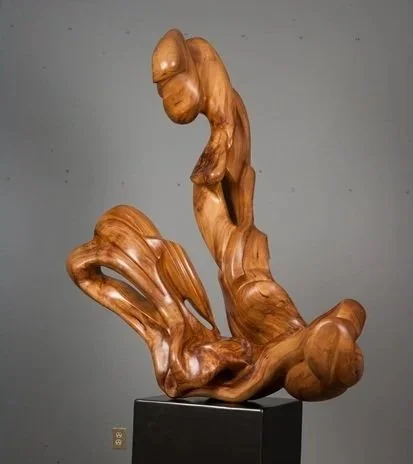
Looking at the works that Laura Leal displayed in her exhibition Desvarío,[1] brought back a childhood memory. In a vestibule, at the foot of the main staircase in a relative’s recently inaugurated house, he placed a black stature made up of a set of twisted figures that I tried to untangle mentally as I stood there in contemplation during my Sunday visits. To my surprise the pieces in Desvarío put me into a similar trance: just like with that familiar sculptural set, I swore they were twisted bodies what Laura Leal was proposing, and even a certain painful form of being of the human bodies that. although evident, I could not untangle. Other than that, I can say that the twists in Laura Leal’s wood and stone are polished to perfection, so treacherously polished –I would dare say- like those of the burnished sculpture at the foot of the stairs, in which two large serpents tormented a man and two young men who tried in vane to free themselves; the holes, edges, jams, smoothness, incrustations, undulations, and the twitching of Leal’s pieces are all touched by a painful piety, just like the one that held me wonderstruck before the black sculpture when I was eight or nine years old. What did that torment try to say? An inscription of the sculpture’s pedestal accompanied the two formidable serpents with elongations of the letter “o” that I read in the name LAOCOONTE, a strange name formed by so many curves.
Now it’s Laura Leal who makes me take a few steps closer to those twisted figures I so dreaded in my childhood. As I said before, upon seeing Desvarío, it was evident but not necessarily clear what was debated there and I said as much to the sculptress in an aside: in certain facets of her works the body is a very evident motif that begins to deform. In other words, when twisting the body folds and unfolds – and I use the term like stretching the letter “o”: the body submits and turns into another, it offers and hides itself, it is pierced and darkened-. But the process doesn’t end there, in a mere plastic abstraction. The folded body in Leal’s sculpture reacts –sometimes violently- in a third facet as if it suddenly let out a scream, a scratch, or a stab to find then in still another facet a solution that I would again call pios, when at last the sculpture turns upon itself and returns to the body, giving the structure a disproportionate suffering. All this in a continuum.
I can’t recall under what circumstance I discovered that the Laocoonte I’d seen was a smaller scale replica in bronze of one of the most celebrated statures of Roman marble. What I do remember is the invariable brilliance of Goethe’s essay “About the Laocoonte” that I read several years later, as a seed in the modern discourse about plastic arts. Goethe states that before the Laocoonte (by the way, he too saw a copy), the spectator may remove all mythological or poetic reference (the story is found in The Iliad), to face simply the suffering of a father who watches his sons threatened by mortal danger. I quote:
“In the face of his own suffering or that of others, man has only three feelings: fear, terror and piety, that is the disquieting feeling that misfortune approaches, the sudden perception of a present suffering and the active compassion before permanent or past suffering. Our work represents and provoke those three feelings and does so in appropriate degrees.”[2]
Goethe opened the critique to the terrain of modern reception, with an early pychologism that had vast consequences on the esthetic ideas of the twentieth century. Goethe is a bridge to classicism. En the romantic pathos, as in the Aristotelian theory, the degree of the emotions leads to tragedy (Goethe refers to the Laocoonte as “a tragic idyll”). For my part, I would like to underscore that it is in the degrees that Laura Leal’s art stands our in her time. It is in that continuum of facets that she takes the body to its tragic deformation. To take hold of the tragic feeling in Laura Leal’s sculpture, I resort to the letter “o” released in the name of Laocoonte, that reveals something even more familiar in the form of alliances or wedding rings. The drama of that sculpture with its convulsions connects with a Cinta de Moebio [E-publication about epistemology] in my mind, not only because of the renewed invasion of the serpents that now squeeze the twisted trunks and tortured branches of Laura Leal, whose insides unfold into exteriors and vice versa, but because of the great care the sculptress takes in the hollows, in the “o”, with extreme attention to what lies in the void, in that nothingness where the sculpture’s space is at stake and where one can sometimes find survival.
[1] Galería Arte Actual Mexicano, Monterrey, 2010.
[2] Goethe, Écrits sur l’art, Flammarion, 1996.
Desvario
Por: Jaime Moreno Villareal
Al observar las obras que Laura Leal reunió en su muestra Desvario,[1] tuve un recuerdo de infancia. En el cubo de un vestíbulo, al pie de la escalera principal en la recién inaugurada casa de un pariente, él había colocado una escultura negra formada por un conjunto de figuras retorcidísimas que yo trataba de desembrollar mentalmente cuando me plantaba ahí en las visitas dominicales. Mi asombro ante las piezas de Desvarío me impuso un trance similar: tal como me ocurría con aquel conjunto escultórico tan familiar, juraría que eran cuerpos retorcidos lo que proponía Laura Leal, y aun cierta forma dolorosa de ser de los cuerpos humanos que, aunque fuera evidente, yo no alcanzaba a desenmarañar. Por lo demás, los retorcimientos de la madera y la piedra de Laura Leal están pulidos a la perfección, tan alevosamente pulidos —diría— como los de aquella escultura bruñida al pie de la escalera, en la que dos grandes serpientes atormentaban a un hombre y dos jóvenes intentaban vanamente liberarse; los huecos, los filos, los aprietos, las suavidades, las incrustaciones, las ondulaciones, los crispamientos en las piezas de Leal, todo está tocado por una dolorosa piedad, tal como la que me mantenía pasmado frente a la escultura negra a los ocho o nueve años de edad. ¿Qué quería decir aquel suplicio? Una inscripción en el zócalo de la escultura acompañaba a las dos formidables serpientes con esos alargamientos de la letra “o” que leía en el nombre de Laocoonte, nombre que doblaba en extrañeza y forma tantas sinuosidades.
Ahora es Laura Leal quien me lleva a dar algunos pasos más hacia esos retorcimientos que temí en la infancia. Como dije líneas arriba, al conocer Desvarío, me resultó evidente pero no necesariamente claro lo que ahí se debatía, y así se lo dije a la escultora: en ciertas facetas de sus obras el cuerpo es un motivo muy patente que se va deformando. Por así decirlo, el cuerpo al retorcerse se dobla y desdobla —y uso el término como alargando la letra “o”: el cuerpo se somete y se hace otro más, se ofrece y se oculta, se horada y oscurece—. Pero el proceso no termina ahí, en una pura abstracción plástica. Resulta que el cuerpo doblado en la escultura de Leal, reacciona —a veces incluso violentamente— en una tercera faceta, como si dejara salir un golpe, un grito, un arañazo o una cuchillada, para luego hallar, en otra faceta aún, una solución que de nuevo llamaría piadosa, cuando por fin la escultura se revuelve sobre sí y vuelve al cuerpo, dándole estructura al sufrimiento desproporcionado. Todo esto, en un continuo.
No recuerdo en qué circunstancias supe después que aquel Laocoonte casero era una copia a escala menor y en bronce de una de las más célebres estatuas de mármol romanas. Lo que sí recuerdo, en cambio, es la brillantez invariable del ensayo de Goethe “Acerca del Laocoonte”, leído muchos años más tarde, como semilla del discurso moderno sobre artes plásticas. Goethe plantea que ante el Laocoonte (por cierto, él también lo conoció a través de una copia) el espectador puede desprenderse de toda referencia mitológica o poética (la historia se encuentra en La Ilíada), para enfrentarse pura y llanamente al sufrimiento de un padre que ve a sus hijos apremiados por un peligro mortal. Cito a continuación:
Ante sus propios sufrimientos o los sufrimientos de otros, el hombre sólo dispone de tres sentimientos: el miedo, el terror y la piedad, es decir el presentimiento inquietante de una desgracia que se acerca, la percepción imprevista de un sufrimiento presente y la compasión activa ante un sufrimiento permanente o pasado. Nuestra obra representa y provoca estos tres sentimientos, y lo hace con gradaciones apropiadas.[2]
Goethe abría la crítica al terreno de la recepción moderna, con un temprano psicologismo que tuvo vastas consecuencias en las ideas estéticas del siglo XX. Goethe es un puente con el clasicismo. En el pathos romántico, como en la teoría aristotélica, la gradación de las emociones encauza a la tragedia (Goethe designa al Laocoonte como “un idilio trágico”). Por mi parte quiero subrayar que es en el renglón de las gradaciones donde el arte de Laura Leal sobresale en su tiempo. Está en ese continuo de facetas que lleva del cuerpo a su deformación trágica. Para apropiarme del sentimiento trágico en la escultura de Laura Leal, recurro a la letra “o” desatada en el nombre de Laocoonte, que se me revela aún más familiar bajo la forma de las alianzas o anillos de esponsales. El drama de aquella escultura, con sus convulsiones, se enlaza como una cinta de moebio en mi mente, no sólo por la renovada irrupción de las serpientes que aprietan ahora los retorcimientos de los troncos y raíces torturados de Laura Leal, cuyos interiores se desdoblan en exteriores y viceversa, sino por el gran cuidado que la escultora deposita en las oquedades, en la “o”, con una atención extrema a lo que resta en el vacío, en esa nada donde se juega el espacio de la escultura y a veces se encuentra la sobrevivencia.
[1] Galería Arte Actual Mexicano, Monterrey, 2010.
[2] Goethe, Écrits sur l’art, Flammarion, 1996.