Laura Leal and Her Sculptural Poetics
By: Luis Carlos Emerich
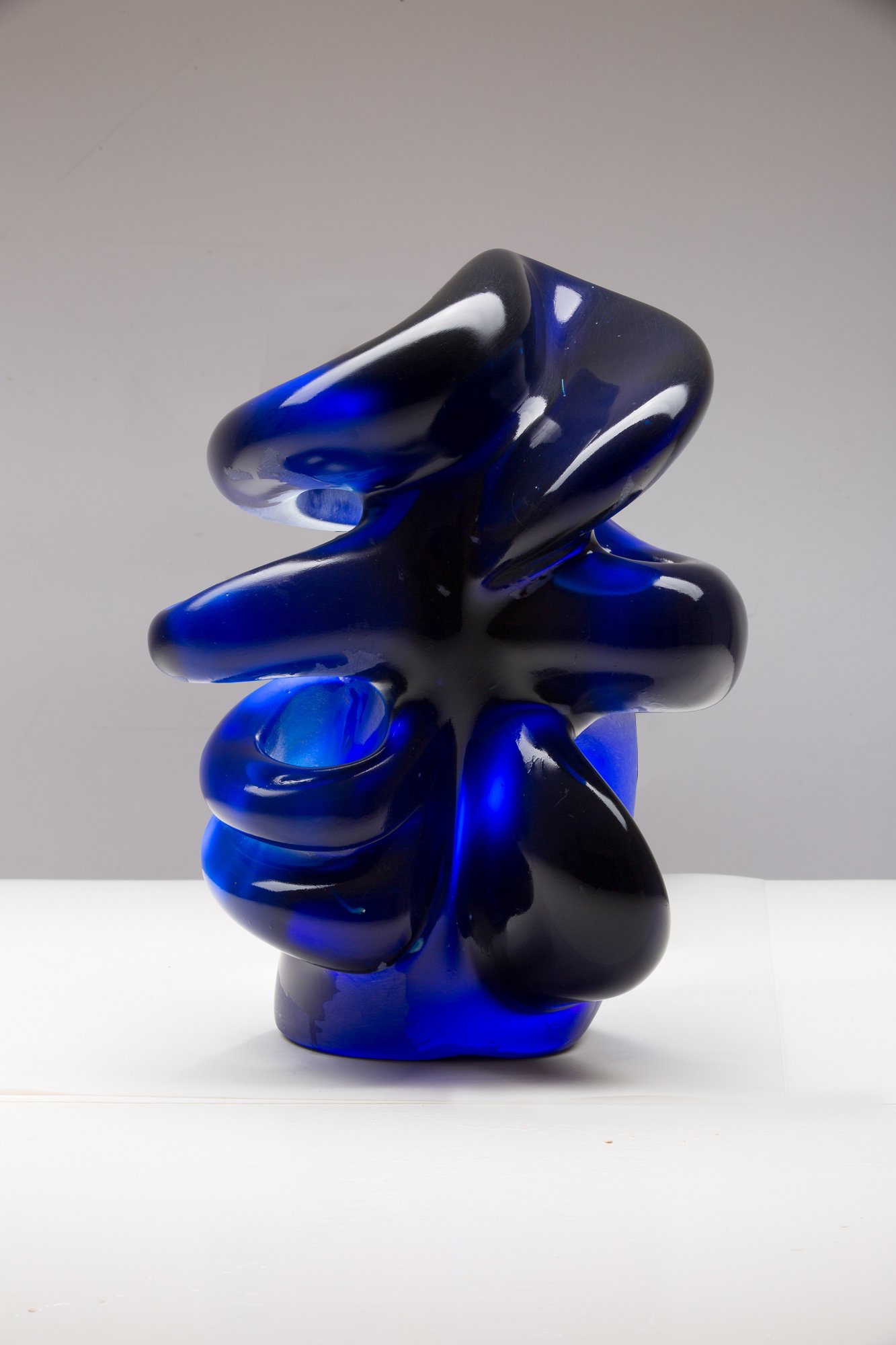
Among the wide range of materials Laura Leal has used throughout her sculptural practice, rock crystal is the only one to possess an ancient symbolic significance of its own. Although it has long been attributed with magical, psychic, and healing powers—including the ability to attract favors from the spiritual world and even to be a “living stone”—its only demonstrable property is its capacity to regulate electrical impulses. More likely, however, Laura Leal chose blue rock crystal, beyond its inherent beauty, to project the central theme of her work into new realms of meaning: the metaphorical materialization of a range of emotional states as diverse as those suggested by the original formations of her materials. These are selected for their potential to evoke psychic structures without the need to depict them and, above all, for their ability to function as sculptural elements through the reflections and refractions of light across finely carved and polished surfaces.
It is therefore the multiple tonalities and chromatic intensities produced by light on the surface and within the material itself that imbue these volumetric forms with a kind of inner latency—an animating quality that would otherwise be absent from forms that are entirely abstract. Unlike her use of artificial light to reveal forms created from translucent and irregular materials, such as her sculptures made from plastic bags and containers, the flow of light across and through the varying densities and volumes of a crystalline medium creates the illusion that a material as hard as it is fragile has become malleable and responsive to touch.
This apparent malleability is the result of a labor-intensive, risky, and prolonged process of handwork that could, in itself, constitute a conceptual proposition. Yet it is clear that its purpose is to give the rock crystal the illusion of organic consistency, while the nuanced intensity of its blue coloration suggests the generation of its own inner light—both qualities that can be extrapolated to the human condition. This alone is enough to convey the quality and depth of what Laura Leal has invested of herself in her sculptural practice. This becomes even more evident when her carved works are presented, as they are here, alongside sculptures produced through the opposite process: the gathering, combining, and binding of found industrial materials, whose dependence on artificial light intensifies the compositional dynamics of their elements and constitutes their very reason for being.
Perhaps, however, the greatest contrast lies in the way her rock crystal sculptures come to be perceived as metaphors. Their ability to transform material into a vessel for emotion, as Leal has done throughout her practice, has manifested itself through such varied purposes over the course of her career that, taken together, her works have formed an expanding and continually diversifying system of poetic-objectual introspection. In contrast, particularly, with the impersonality often associated with contemporary art, these works acquire an added sense of human warmth—at times dramatic, at times sensual, but always provocative. And beneath it all, perhaps, they are not entirely indifferent to the magic that continues to be attributed to the material to this day.
Laura Leal y su poética escultórica
Por: Luis Carlos Emerich
Entre la gran diversidad de materiales que ha utilizado Laura Leal en su obra escultórica, el cristal de roca es el único que posee una antiquísima carga simbólica propia. Aunque se le han atribuido poderes mágicos, psíquicos y curativos, e incluso el de atraer favores del mundo espiritual y hasta el de ser una “piedra viva”, su única virtud comprobable es la de regular impulsos eléctricos. Pero es más seguro es que Laura Leal haya elegido el cristal de roca azul –más allá de su propia belleza‒ para proyectar a nuevos planos de significación el tema unificador de toda su obra, es decir, la materialización metafórica de una gama de estados anímicos de tan distinta naturaleza como los sugeridos por las conformaciones originales de sus materiales, elegidas por su potencial para sugerir estructuras síquicas sin necesidad de figurarlas, y sobre todo, para utilizar como elementos escultóricos los reflejos y refracciones de la luz sobre cuerpos finamente esculpidos y pulidos. De allí que las múltiples tonalidades e intensidades cromáticas generadas por la luz sobre la superficie y a través del alma del material, sean las que infundan una especie de latencia interna a formas volumétricas que serían totalmente abstractas sin ese aliento luminoso. A diferencia del uso de la luz artificial para revelar formas generadas por materiales translúcidos e irregulares, como en sus esculturas hechas con bolsas y botes de plástico, el flujo de la luz sobre y a través de distintas densidades y volúmenes de un medio cristalino, crea la ilusión de que un material tan duro como frágil se ha tornado maleable y sensible al tacto.
Esta virtual maleabilidad es producto de un trabajo manual tan arduo, riesgoso y dilatado que bien pudiera constituir por sí mismo una propuesta conceptual, pero es claro que su objetivo es infundirle al cristal de roca la ilusión de poseer consistencia orgánica y a la matización de su intenso color azul, la de generar luz propia, ambas extrapolables a la condición humana. Esto bastaría para asegurar que esa es la calidad y la profundidad de lo que Laura Leal ha dado de sí misma a su trabajo escultórico. Esto es más evidente cuando sus obras esculpidas se confrontan, como en esta ocasión, con esculturas realizadas mediante el proceso contrario, es decir, mediante acopio, combinación y aglutinación de materiales industriales encontrados que requieren de la luz artificial para pronunciar la dinámica compositiva de sus elementos, que es su razón de ser.
Sin embargo, quizás el mayor contraste sea el que hace que sus esculturas de cristal de roca se perciban como metáforas, pues su virtud de convertir un material en un continente emocional, como lo ha hecho en toda su obra, se ha manifestado con tan distintos propósitos a lo largo de su carrera que en su conjunto constituyen ya todo un sistema de introspección poética-objetual en constante expansión y diversificación, al cual ‒sobre todo por contraste con la impersonalidad del arte contemporáneo— se les da por añadidura la sensación de calidez humana, a veces dramática, a veces sensual, pero siempre provocativa y, en el fondo, tal vez no tan indiferente ante la magia que se le sigue atribuyendo hasta hoy al material.